
MOTS-c Overview
MOTS-c, a peptide derived from mitochondria, offers a range of benefits for our health. It
helps maintain a balanced metabolism and has been associated with a longer lifespan.
Additionally, MOTS-c has shown potential in improving exercise performance, reducing
obesity, combating insulin resistance, and addressing various disease pathways, including
osteoporosis. Its diverse positive effects make MOTS-c an exciting area of research with
implications for enhancing overall well-being.
The term MOTS-c stands for “Mitochondrial Open Reading Frame of the 12S rRNA Type-c.”
It refers to a short peptide derived from the mitochondrial genome.
Mitochondria are organelles found in most eukaryotic cells that play a crucial role in generating
energy through cellular respiration. The mitochondrial genome is separate from the nuclear
genome and encodes several essential proteins involved in mitochondrial function.
MOTS-c is a recently discovered peptide encoded within the mitochondria that has attracted
scientific interest due to its potential regulatory roles in metabolism and aging. It is derived from
the 12S rRNA (ribosomal RNA) gene, part of the mitochondrial DNA.MOTS-c Structure
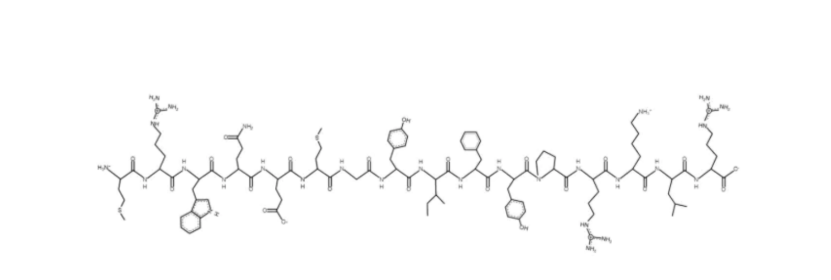
MOTS-C Structure, De BQUB17-JHolguera – Trabajo propio, CC BY-SA 4.0
Source: Wikipedia
Sequence: Met-Arg-Trp-Gln-Glu-Met-Gly-Tyr-Ile-Phe-Tyr-Pro-Arg-Lys-Leu-Arg
● Molecular Formula: C101H152N28O22S2
● Molecular Weight: 2174.64 g/mol
● PubChem SID: 255386757
● CAS Number: 1627580-64-6
● Synonyms: Mitochondrial open reading frame of the 12S rRNA-c, MT-RNR1
Muscle Metabolism
Research has shown that MOTS-c increases skeletal muscle following long-term aerobic
exercise training. This increase contributes to skeletal muscle adaptation through fast-to-slow
phenotypic shifts and an expansion of mitochondrial networks.
MOTS-c also reduces myostatin expression, a protein that inhibits muscle growth. By reducing
myostatin, MOTS-c helps prevent muscle wasting and promotes muscle growth.
Furthermore, MOTS-c treatment has improved physical performance in mice of different
ages. It regulates skeletal muscle metabolism and potentially enhances glucose effectiveness
within skeletal muscle.
The peptide has also demonstrated the ability to reduce high-fat-diet-induced muscle
atrophy signaling by decreasing myostatin expression.
Fat Metabolism
Fat metabolism plays a crucial role in energy production and overall metabolic health. MOTS-c,
a novel mitochondrial-derived peptide, has been studied for its impact on fat metabolism. Here
are some key findings related to fat metabolism and MOTS-c:
MOTS-c has been found to regulate muscle and fat metabolism. It has shown promising effects
in preventing diet-induced obesity in mice fed a high-fat diet.
In studies involving exercise-induced mitochondrial adaptations, MOTS-c has been shown
to increase lipid utilization and reduce total fat mass. This suggests its potential role in
enhancing fat metabolism.
MOTS-c treatment has demonstrated preventive effects against obesity in mice fed a high-fat
diet. However, it does not affect the weight of mice fed a normal diet.
Additionally, MOTS-c has been found to increase fatty acid oxidation and regulate white
adipose lipid metabolism, potentially activating brown adipose tissue.
The peptide coordinates cellular glucose, mitochondrial, and fatty acid metabolism, potentially
influencing lipid metabolism.

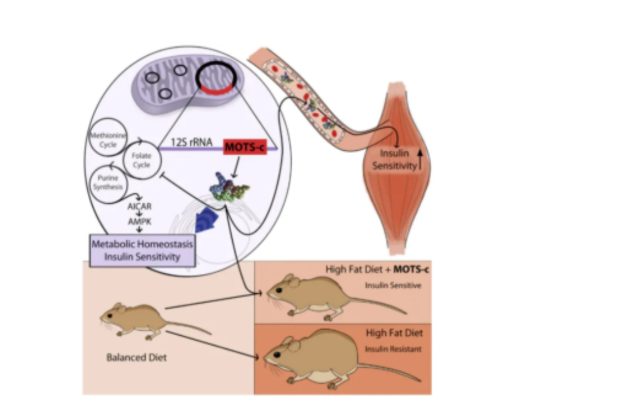
MOTS-c has effects in both the mitochondria and the nucleus.
Source: Cell Metabolism
Evidence from studies in mice suggests that MOTS-c, particularly in the context of obesity, plays
a significant role in regulating sphingolipid, monoacylglycerol, and dicarboxylate metabolism. By
modulating these pathways and promoting increased beta-oxidation, MOTS-c appears to inhibit
the accumulation of fat. Some of these effects are likely mediated through MOTS-c’s actions in
the nucleus. The exploration of MOTS-c has given rise to a novel hypothesis regarding fat
deposition and insulin resistance, which is gaining traction within the scientific community and
might provide a fresh approach for intervening in the pathophysiology of obesity and diabetes.
It appears that dysregulation of fat metabolism within mitochondria may lead to insufficient fat
oxidation. Consequently, this results in elevated levels of circulating fats, prompting the body to
elevate insulin levels in an attempt to clear lipids from the bloodstream. This action ultimately
leads to increased fat storage and a homeostatic adjustment in the body, gradually adapting
(and developing resistance) to persistently elevated insulin levels.
MOTS-c supplementation in rats prevents mitochondrial dysfunction and prevents the
accumulation of fat even in the setting of a high-fat diet.
Source: Cell Metabolism
Insulin Sensitivity
Insulin sensitivity means that the body isn’t able to effectively respond to and utilize insulin, a
hormone that helps regulate blood sugar levels. Research has explored the relationship
between MOTS-c, a mitochondrial-derived peptide, and insulin sensitivity. Here are some key
findings related to insulin sensitivity and MOTS-c:
Studies have shown that lower levels of MOTS-c are associated with markers of insulin
resistance in obese male children and adolescents. This suggests that MOTS-c may play a
role in improving insulin sensitivity.
MOTS-c has been found to alleviate hyperglycemia, improve insulin sensitivity, and
enhance glucose tolerance. These effects may contribute to better blood sugar control and
reduced insulin resistance.
In mouse models fed a high-fat diet, MOTS-c has been shown to reduce insulin resistance by
targeting skeletal muscle. This suggests that MOTS-c may have potential therapeutic
applications for conditions related to insulin resistance, such as type 2 diabetes.
Treatment with MOTS-c has demonstrated the ability to prevent age-dependent and
high-fat-diet-induced insulin resistance. Additionally, it has shown promise in preventing
diet-induced obesity, further highlighting its potential impact on metabolic health.
MOTS-c has been found to improve metabolic homeostasis and lessen insulin resistance. Initial
studies have shown modest body weight reductions and food metabolism improvements.
Osteoporosis
Osteoporosis is characterized by weakened and brittle bones, making them more susceptible to
fractures. The disease involves the loss of bone mass and a disruption in bone remodeling
processes. While osteoporosis is primarily attributed to factors such as aging, hormonal
changes (especially in women after menopause), and certain medical conditions, recent
research has explored the potential role of MOTS-c, a mitochondrial-derived peptide, to
osteoporosis.
Studies have shown that MOTS-c may have a protective effect on bone health. It has been
found to enhance osteoblast differentiation and activity, which are responsible for bone
formation.
In animal models, MOTS-c treatment has demonstrated the potential to prevent bone loss and
increase bone mineral density. This suggests that MOTS-c may have a beneficial impact on
bone strength and reduce the risk of fractures.
MOTS-c has also been found to regulate gene expression in bone metabolism and
remodeling processes. By modulating these genes, MOTS-c may contribute to maintaining
bone homeostasis and preventing excessive bone loss.
Additionally, MOTS-c has shown the potential to improve bone healing and regeneration. This
suggests its ability to support the repair and recovery of bone tissue, which is particularly
relevant in the context of fractures associated with osteoporosis.
Longevity
The connection between longevity and MOTS-c has been a topic of scientific investigation.
Multiple studies have explored the potential relationship between MOTS-c and exceptional
longevity.
The mitochondrial-derived peptide MOTS-c has been identified as a potential player in
exceptional longevity, referring to individuals who live longer than average. This suggests that
MOTS-c may have a role in promoting a longer lifespan.
Studies have found a putative biological link between MOTS-c and exceptional longevity
through specific genetic variations, such as the m.1382A>C mtDNA variant. These genetic
associations indicate that MOTS-c may influence longevity by interacting with
mitochondrial DNA.
MOTS-c has been implicated in muscle homeostasis and physical activity, which are
associated with healthy aging and longevity. Its involvement in maintaining muscle function and
overall physical well-being may contribute to an extended lifespan.
Experimental evidence indicates that MOTS-c treatment, particularly in conjunction with
exercise, may positively impact overall longevity. However, further research with larger
cohorts is required to confirm and generalize these findings.
While the precise mechanisms underlying the relationship between MOTS-c and longevity are
not yet fully understood, it is proposed that MOTS-c’s effects on metabolic disorders, glucose
regulation, and mitochondrial function may contribute to promoting a longer lifespan.
Heart Health
Cardiac structure and function: Studies have shown that both aerobic exercise and MOTS-c
treatment can reduce abnormalities in cardiac structure and improve cardiac function.
MOTS-c has been observed to enhance cardiac systolic function, improve diastolic function,
and increase myocardial mechanical efficiency.
Repairing myocardial damage: MOTS-c has demonstrated the ability to repair myocardial
damage by inhibiting certain processes involved in cardiovascular complications,
particularly diabetes. It has been suggested as a potential therapeutic target for the
cardiovascular complications associated with diabetes.
Prevention of cardiac dysfunction: Treatment with MOTS-c has shown promise in delaying
the development of cardiac dysfunction and structural dilation. This implies that MOTS-c
may play a preventive role in preserving cardiovascular health.
Vascular and heart abnormalities: MOTS-c has been reported to improve vascular
endothelial function and attenuate vascular and heart abnormalities. These effects
contribute to overall cardiovascular health and function.
Predictive role in cardiovascular disease: Population studies have explored the predictive
role of MOTS-C in cardiovascular disease. Circulating MOTS-C levels have been associated
with cardiovascular disease risk, and decreased levels of MOTS-C have been observed in
certain patient populations.
Please note that all the articles and product information provided on this website are intended
for informational and educational purposes only.
The products offered on this platform are specifically designed for in-vitro studies, meaning they
are conducted outside the body. It is important to clarify that these products are not medicines or
drugs, and the FDA has not approved them for the prevention, treatment, or cure of any medical
condition, ailment, or disease.
Article Author
The above literature was researched, edited and organized by Dr. Logan, M.D. Dr. Logan holds
a doctorate degree from Case Western Reserve University School of Medicine and a B.S. in
molecular biology.