

Highlights
● LL-37 effectively combats bacteria, fungi, and viruses, showing promise against
antibiotic-resistant strains.
● Regulating inflammation and aiding in the defence against fungal infections, LL-37
influences immune responses.
● Offering new strategies for treating chronic infections, LL-37 disrupts biofilms, particularly
in antibiotic-resistant bacteriaDisplaying both anti- and pro-cancerous effects, LL-37
plays a complex role, impacting immune responses and signalling pathways.
Abstract
Antimicrobial peptides (AMPs) represent a unique group of naturally occurring molecules having
diverse biological activities, including potent antimicrobial properties. Among them, LL-37 has
emerged as a significant player, demonstrating its multifaceted roles during bacterial, fungal,
and viral infections, as well as exhibiting intriguing implications in cancer. This review delves into
the versatile functions of LL-37, elucidating its mechanisms of action against microbial
pathogens and its potential to modulate immune responses. We explored the efficacy of LL-37
in disrupting bacterial membranes, inhibiting fungal growth, and interfering with viral replication,
highlighting its potential as a therapeutic agent against a wide array of infectious diseases.
Furthermore, we discussed the emerging role of LL-37 in cancer immunity, where its
immunomodulatory effects and direct cytotoxicity towards cancer cells offer novel avenues for
cancer therapy in the near future. We provided a comprehensive overview of the activities of
LL-37 across various diseases and underscored the importance of further research into
harnessing the therapeutic potential of this potential antimicrobial peptide along with other
suitable candidates.
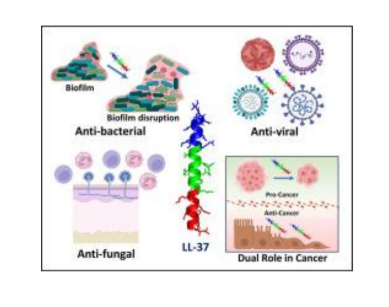
Graphical abstract


Introduction
All multicellular organisms are constitutively exposed to millions of pathogens through their
surroundings, whether through inhalation, ingestion, or direct contact in their daily lives. Mostly
these pathogens do not colonies in their host, however, sometimes they infect the host, leading
to serious morbidity or mortality [1]. To prevent any pathogens from infecting the host or to fight
these pathogens, all hosts have their defence mechanisms which involve several molecules,
cells, and organs that collectively make the host immune system. This defence mechanism
consists of chemical, physical, mechanical, and biochemical barriers as well as inducible
systems such as innate and adaptive immune systems [2,3].
Among these diverse collections of molecules is a group of small peptides called ‘Antimicrobial
peptides (AMPs)’, these AMPs widely exist in nature and are part of the innate immune system
of the host [4]. AMPs constitute a varied group of defensive peptides that participate in several
cellular and innate immune processes [5]. These molecules are typically 6-100 amino acids long
and are produced by microbes, plants, and animals. AMPs possess potent antimicrobial,
antiviral, and antifungal activities, qualifying them as novel therapeutic agents [6].
Among the AMPs, LL-37 has emerged as a key player in host immune defence. Discovered for
its ability to inhibit Cathepsin-L, LL-37 has been identified in various species, including humans,
guinea pigs, horses, rats, mice, and rhesus monkeys [[7], [8], [9], [10], [11]]. LL-37 exhibits a
wide range of activities, including pro-inflammatory and anti-inflammatory responses, induction
of chemokine expression, and modulation of immune cell function. Notably, the role of LL-37
extends beyond immune defence, encompassing activities in cancer biology. It exhibits both
pro-apoptotic effects and activities against bacteria, fungi, and parasites. The multifaceted role
of LL-37 in cancer includes both promotion and suppression, highlighting its significance in
tumor immunity and antitumor activity.