
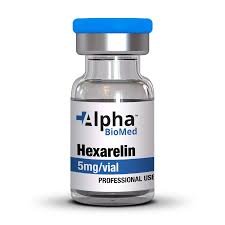
Hexarelin is a synthetic growth hormone secretagogue known for its potential benefits. It
stimulates the release of growth hormones in the body and has been studied for its
cardiovascular effects. Hexarelin may have implications for muscle growth, fat loss, and
enhanced tendon and ligament strength.
Benefits of Hexarelin
Hexarelin is a peptide that has been studied for its potential benefits, although it’s important to
note that much of the research is still in progress. Here are some of the reported benefits:
Increased muscle growth: Hexarelin has shown the ability to stimulate the release of growth
hormone, which can promote protein synthesis and lead to increased muscle mass.
Accelerated fat loss: By enhancing lipolysis the breakdown of stored fat, Hexarelin may
contribute to weight loss and fat loss.
Enhanced collagen production: Hexarelin has been found to increase collagen synthesis,
supporting connective tissue health and potentially improving joint function.
Improved recovery and injury healing: Hexarelin may accelerate the repair of soft tissues,
such as muscles and tendons, leading to faster recovery from workouts and injuries.
Increased bone density: Some studies suggest that Hexarelin could positively affect bone
mineral density, potentially reducing the risk of osteoporosis.
Enhanced physical performance: The combination of increased muscle mass, improved
recovery, and other factors may contribute to enhanced physical performance in athletes and
fitness enthusiasts.
DISCLAIMER:
This PRODUCT IS INTENDED FOR RESEARCH PURPOSES ONLY. It is designed for in vitro
testing and laboratory experimentation exclusively. All the information provided on this website
is purely for educational purposes. Under the law, any form of bodily introduction of this product
into humans or animals is strictly prohibited. It is essential that only licensed and qualified
professionals handle this product. This product is not intended to be used as a drug, food, or
cosmetic. It must not be misbranded, misused, or mislabeled as such. Its purpose and usage
are solely confined to research and scientific investigation.
Description
What is Hexarelin?
Hexarelin is a synthetic peptide that belongs to the family of growth hormone-releasing
peptides (GHRP). It stimulates the release of growth hormone and (IGF-1) levels of insulin-like
growth factor 1 in the body. Hexarelin acts on the pituitary gland and promotes the secretion
of growth hormones, which can have various effects, such as increasing muscle mass,
reducing body fat, improving recovery time, and enhancing overall athletic performance.
Hexarelin Structure
● Chemical Name: Hexarelin
● Sequence: His-D-2Methyl-Trp-Ala-Trp-D-Phe-Lys-NH2
● Molecular Formula: C47H58N12O6
● Molecular Weight: 887.0 g/mol
● PubChem CID: 6918297
● CAS Number: 140703-51-1
● Synonyms: EP-23905, MF-6003
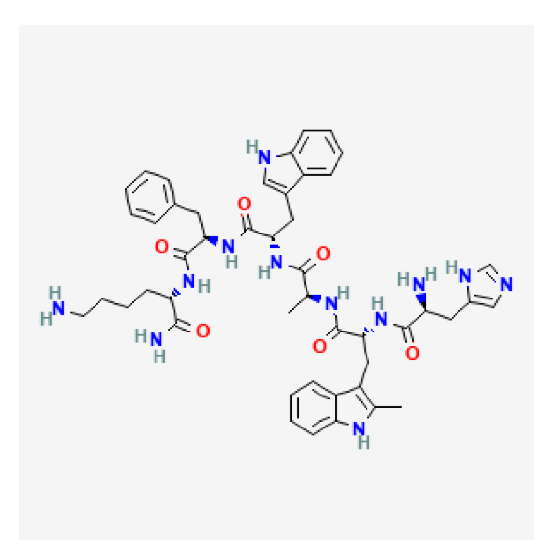
Source: PubChem
How Does Hexarelin Work?
Hexarelin works by interacting with the ghrelin receptor, which is primarily found in the
pituitary gland. When Hexarelin binds to this receptor, it stimulates growth hormone release from
the pituitary gland.
By increasing the levels of growth hormone in the body, Hexarelin can have several effects.
Growth hormone is known to promote protein synthesis, which can lead to increased muscle
mass and strength. It also can potentially reduce body fat by enhancing lipolysis, the
breakdown of stored fat.
Additionally, Hexarelin has been shown to increase levels of insulin-like growth factor 1
(IGF-1), which is a hormone that plays a crucial role in tissue growth and repair. IGF-1 is
produced in response to growth hormone stimulation and can contribute to the anabolic effects
of Hexarelin.
Hexarelin and Cardiovascular Health
Hexarelin, a growth hormone secretagogue, has shown potential benefits in cardiovascular
health. Several studies have investigated the effects of Hexarelin on preserving myocardial
function, targeting neuroinflammatory pathways, and improving cardiac outcomes.
One study highlights that Hexarelin treatment preserves myocardial function and improves
cardiac performance. The study suggests that Hexarelin has cardioprotective effects and may
contribute to better heart function.
Additionally, another research report shows that chronic administration of Hexarelin attenuates
cardiac fibrosis, which is the excessive thickening of the heart muscle. This finding indicates
that Hexarelin may have a role in reducing cardiac fibrosis and potentially improving
cardiovascular health.
Furthermore, research published in ScienceDirect demonstrates that Hexarelin targets
neuroinflammatory pathways, potentially leading to the preservation of cardiovascular function.
This suggests that Hexarelin’s effects extend beyond muscle growth and may positively impact
the cardiovascular system.
Hexarelin and Collagen Production
Hexarelin has also been studied for its potential effects on collagen production. Research
suggests that Hexarelin may impact suppressing cardiac fibroblast proliferation and
collagen synthesis.
A study demonstrated that Hexarelin suppresses cardiac fibroblast proliferation and collagen
synthesis in rats. The study concludes that Hexarelin inhibits DNA and collagen synthesis as
well as the proliferation of cardiac fibroblasts through the activation of the growth hormone
secretagogue receptor (GHSR) and A(2) receptor (A(2)R).
These findings suggest that Hexarelin may modulate collagen production, which is crucial in
tissue repair and maintenance. However, further research is needed to fully understand the
mechanisms and implications of Hexarelin’s effects on collagen synthesis.
Hexarelin and Increased Muscle Growth
One research showed that long-term Hexarelin therapy positively affected growth hormone
levels, potentially leading to increased muscle growth. Another study published in the National
Center for Biotechnology Information (NCBI) demonstrated that Hexarelin administration
improved muscle growth and function in animal models.
Hexarelin is believed to enhance growth hormone release, stimulate cell regeneration, and
encourage muscle reproduction. These effects may contribute to muscle strength, size, and
overall performance improvements.
Potential Side Effects of Hexarelin
Hexarelin is a peptide that is sometimes used in research and bodybuilding. It’s important to
note that Hexarelin is not approved for medical use and should only be used under proper
supervision and guidance.
While research on Hexarelin is ongoing, potential side effects have been reported.
Tiredness and lethargy: Some users have reported feeling tired or lethargic after using
Hexarelin.
Water retention: Excessive dosage of Hexarelin may lead to water retention in the body.
Tingling or numbness: Some individuals may experience tingling or numbness in their hands
and feet after using Hexarelin.
Stimulatory effect: Hexarelin may have a stimulatory effect on the body, although the specifics
of this effect are not well-documented.
Androgenic side effects: Unlike some other peptides, Hexarelin does not lead to androgenic
side effects such as hair loss, acne, or virilization in women.
Increased cortisol: Hexarelin has the potential to increase cortisol levels in a dose-dependent
manner, which may lead to chronic effects.
Please note that all the articles and product information provided on this website are intended
for informational and educational purposes only.
The products offered on this platform are specifically designed for in-vitro studies, meaning they
are conducted outside the body. It is important to clarify that these products are not medicines or
drugs, and the FDA has not approved them for the prevention, treatment, or cure of any medical
condition, ailment, or disease.
Sources:
https://www.sciencedirect.com/topics/neuroscience/hexarelin
https://pubmed.ncbi.nlm.nih.gov/9801989/
https://academic.oup.com/jcem/article/83/5/1644/2865542
https://www.mayoclinic.org/drugs-supplements/degarelix-subcutaneous-route/side-effects/drg-2
0072529
https://www.sciencedirect.com/science/article/pii/S0753332220303577
https://journals.physiology.org/doi/full/10.1152/ajpheart.00257.2011
https://physoc.onlinelibrary.wiley.com/doi/full/10.14814/phy2.13699
https://pubmed.ncbi.nlm.nih.gov/17766487/
https://academic.oup.com/jcem/article/83/5/1644/2865542
https://www.ncbi.nlm.nih.gov/pmc/articles/PMC5638899/