
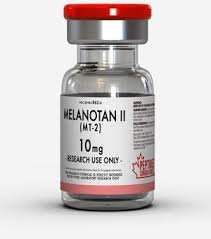
What Is Melanotan II (MT-2)?
Melanotan II (MT-2) is a synthetic variant of human alpha-melanocyte-stimulating hormone
(α-MSH). Its development traces back to the 1980s at the University of Arizona when
researchers discovered that α-MSH induced sexual arousal in rodents and darkened the skin.
Initially intended as a sunless tanning solution, MT-2 eventually revealed a diverse array of
effects, including:
● Increasing sexual arousal
● Promoting tanning or skin pigmentation
● Reducing compulsive behavior
● Controlling addiction
● Fighting hunger
● Reducing glucagon production
● Reversing certain features of autism
Melanotan II (MT-2) is a synthetic analogue of alpha-melanocyte-stimulating hormone, created
in the 1980s. This peptide has been found to have various effects, including enhancing sexual
arousal, reducing compulsive/addictive behaviors, suppressing hunger, and supporting the
development of lean body mass. Additionally, research suggests that MT-2 stimulates
melanocytes, leading to increased skin pigmentation, and there is also potential for its use in
combating autism when administered during early childhood development.
DISCLAIMER:
This PRODUCT IS INTENDED FOR RESEARCH PURPOSES ONLY. It is designed for in vitro
testing and laboratory experimentation exclusively. All the information provided on this website
is purely for educational purposes. Under the law, any form of bodily introduction of this product
into humans or animals is strictly prohibited. It is essential that only licensed and qualified
professionals handle this product. This product is not intended to be used as a drug, food, or
cosmetic. It must not be misbranded, misused, or mislabeled as such. Its purpose and usage
are solely confined to research and scientific investigation.
Melanotan II Peptide Structure
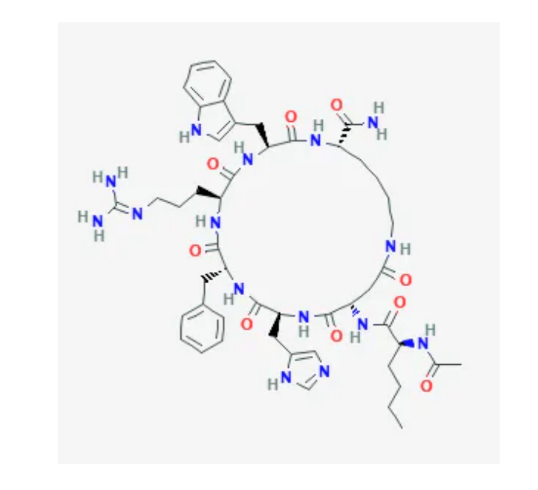
Source: PubChem
Melanotan II Research
Melanotan II and Melanocortin Signaling
Melanotan II exerts its effects by interacting with various melanocortin receptors, which are part
of a group of five distinct receptors, each serving different functions. Notably, MT-2 primarily
binds to MC-4R and MC-1R, with a weaker affinity for MC-3R.
Here’s a breakdown of the known functions of these melanocortin receptors:
MC-1R: Found on melanocytes, the activation of MC-1R leads to the darkening of both the skin
and hair.
MC-2R: Located in the adrenal glands, MC-2R binding stimulates the secretion of adrenal
hormones, including cortisol.
MC-3R: Although its precise role is not fully understood, MC-3R appears to be involved in
appetite control and energy regulation.
MC-4R: Activation of MC-4R brings about changes in feeding patterns and sexual behavior.
Additionally, it influences male erectile function and energy homeostasis.
MC-5R: MC-5R is present on sweat glands and pancreatic islet cells, although further details
about its functions are currently limited.
Melanotan II and Autism
The most recent research on MT-2 has uncovered promising findings, indicating that this
peptide can potentially reverse certain autistic features in a widely used mouse model of autism
spectrum disorder (ASD). Currently, there is no specific treatment for ASD, but recent studies
have suggested that oxytocin therapy might be helpful in mitigating some of the behavioral
challenges associated with the condition. In this context, researchers utilized a mouse model of
maternal immune activation known to result in autism and investigated whether MT2, known for
stimulating oxytocin release, could counteract ASD or reduce typical ASD behaviors.
Their research unveiled significant results, showing that administration of MT-2 effectively
reversed the decreased communication, impaired social interaction, and repetitive behaviors
commonly associated with autism in this particular model. Interestingly, the researchers also
observed that MT-2 administration led to an increase in the expression of oxytocin receptors in
specific brain regions, implying a direct correlation between oxytocin signaling in those areas
and the expression of ASD-specific behaviors[1]. These findings offer a promising avenue for
further exploration and potential therapeutic interventions for ASD.
Impact of MT-2 on sociability in rats with ASD (MIA) showing that MT-2 returns sociability ratings
to near the baseline of control animals (C57).
Source: PubMed
These findings not only suggest potential avenues for developing a treatment for ASD, they
have helped to define a specific brain pathway that may be integral to the development of ASD
in the first place. These findings could help scientists develop a complete model of ASD and
thus both treatments and preventative measures.
Melanotan II and Hunger
There is compelling evidence indicating that MT-2 can effectively reduce fat storage and hunger
behavior in animal models. Researchers have discovered that MT-2 acts as a potent agonist of
the melanocortin-4 receptor (MC-4R), which plays a crucial role in food preferences and intake.
Administering MT-2 to mice results in significant reductions in food consumption and alters their
preference for fatty foods. Surprisingly, mice given MT-2 ignore fatty foods, which they would
otherwise prefer. Conversely, mice lacking the MC-4R receptor show an exclusive preference
for fatty foods and are unaffected by MT-2’s effects[2].
The impact of MT-2 on satiety is akin to that of leptin, often referred to as the “satiety hormone”
due to its ability to reduce cravings and food intake. However, leptin has not proven effective in
treating obesity, even in individuals deficient in leptin. This discrepancy may be attributed to two
distinct pathways for satiety, known as the leptin-dependent and leptin-independent pathways.
Research suggests that MT-2 more effectively stimulates both pathways, making it a potentially
more efficacious exogenous treatment for reducing hunger[3], [4]. This notion is further
supported by the finding that MC-4R stimulation also affects the gene expression of
thyrotropin-releasing hormone (TRH), which is associated with the leptin-satiety pathway[5].
Both MT-2 and leptin are believed to increase TRH expression in the paraventricular nucleus of
the hypothalamus, a region of the brain linked to satiety and food intake. However, only MT-2
crosses into the central nervous system at concentrations high enough to impact TRH
expression.
Melanotan II and Diabetes
The development of diabetes is characterized by elevated blood sugar levels, excessive
glucagon secretion, and the production of ketone bodies[6]. Over time, it has been established
that leptin effectively counteracts these factors by promoting glucose uptake, inhibiting glucagon
production, and interfering with the pathway that leads to ketone body formation. Importantly,
these actions do not rely on insulin, making leptin signaling an intriguing alternative avenue for
potential diabetes treatment.
Studies have demonstrated that leptin’s impact on blood sugar is mediated through
melanocortin receptors, and interestingly, MT-2 elicits similar effects[7]. This finding holds
significance because leptin primarily exerts its effects in the brain but encounters difficulty
crossing the blood-brain barrier as effectively as MT-2. Consequently, when leptin is
administered exogenously, it does not reach the central nervous system (CNS) in significant
quantities, diminishing its effectiveness as a drug and giving MT-2 an advantage. Despite both
peptides having nearly identical effects on melanocortin receptors, MT-2’s ability to more readily
reach the CNS provides it with a valuable edge.
Melanotan II, Impulse Control and Alcohol Intake
Building on the notion that MT-2 might influence oxytocin signaling and consequently impact
behavior in ASD, research also indicates that the MC-4R receptor could be involved in impulse
control. Previous studies in rats have demonstrated that MT-2 administration reduces alcohol
intake and increases water intake, even in rats with a preference for alcohol[8]. More recent
investigations have shown that melanotan-2 works synergistically with naltrexone, significantly
enhancing its efficacy by more than seven-fold, effectively reducing binge-like ethanol intake in
mice[9].
Percent of baseline alcohol consumption in mice treated with naltrexone or naltrexone and
MT-2.
Source: PubMed
The discoveries indicate that MT-2 could serve as more than just a valuable treatment for
alcohol-related disorders. Instead, the peptide seems to be influencing a fundamental
mechanism of craving and desire within the mammalian brain. This research has the potential to
unveil broader insights not only into alcohol abuse and hunger but also the involvement of
oxytocin in impulsive behavior. Moreover, it might pave the way to identify craving pathways and
enhance our comprehension of human motivation, impacting various aspects of life, from work
to relationships.
Melanotan 2 and Erectile Dysfunction
Erectile dysfunction (ED) is frequently linked to vascular issues, and it can be successfully
addressed in most men through medications like sildenafil (Viagra) and similar drugs that
enhance blood flow by reducing vascular resistance. However, not all cases of ED are solely
related to vascular problems, which renders sildenafil and similar drugs ineffective for a small
percentage of men and the majority of women who suffer from hypoactive sexual desire
disorder.
MT-2 has long been recognized as an effective treatment for ED, but research indicates that its
impact extends beyond drugs like sildenafil, primarily due to its actions in the central nervous
system. A study involving men who had previously failed to respond to Viagra revealed that
eighty percent of them experienced positive results with MT-2 treatment[10]. Furthermore, MT-2
has been the subject of active investigation as a potential treatment for sexual desire disorders
in both men and women.
Future MT-2 Research
MT-2 is a extensively studied peptide, particularly concerning its effects on human behavior,
sexual desire, and impulse control. Clinical trials have explored various forms of the peptide, but
challenges with routes of administration have required researchers to reevaluate their
approaches. Nonetheless, active and ongoing research continues to uncover the potential
benefits of MT-2.
In terms of safety, MT-2 demonstrates minimal to moderate side effects, exhibits low oral
bioavailability, and excellent subcutaneous bioavailability in mice. However, it is important to
note that the per kg dosage in mice does not directly translate to humans. Consequently, MT-2
available for purchase at Peptide Sciences is strictly intended for educational and scientific
research purposes only, and it is not meant for human consumption. Therefore, MT-2 should
only be obtained by licensed researchers.
Article Author
The above literature was researched, edited and organized by Dr. Logan, M.D. Dr. Logan holds
a doctorate degree from Case Western Reserve University School of Medicine and a B.S. in
molecular biology.
Scientific Journal Author
Dr. Wessells is a UW professor, chair of the Department of Urology, and has served on several
national and international professional and government committees, including the WHO
International Consultations on Erectile and Sexual Dsyfunction, an NIDDK working group on
urological complications of diabetes, and a NIH symposium on diabetes. He is a surgeon,
researcher and expert on urogenital trauma and erectile dysfunction. His clinical interests
include reconstructive surgery of the genitourinary tract, acute injury management and complex
surgery for male sexual dysfunction. His research interests are in urogenital trauma
epidemiology and management; the physiology and pathophysiology of erectile dysfunction;
reconstructive surgery; crash injury mechanics; and urological complications of diabetes. A
proerectile melanocortin agonist developed by Dr. Wessells and his collaborators at the
University of Arizona is in clinical trials for the treatment of erectile dysfunction.
Dr. Wessells is being referenced as one of the leading scientists involved in the research and
development of Melanotan 2. In no way is this doctor/scientist endorsing or advocating the
purchase, sale, or use of this product for any reason. There is no affiliation or relationship,
implied or otherwise, between Peptide Sciences and this doctor. The purpose of citing the
doctor is to acknowledge, recognize, and credit the exhaustive research and development
efforts conducted by the scientists studying this peptide. Dr. Wessells is listed in [11] and [12]
under the referenced citations.
Referenced Citations
E. Minakova et al., “Melanotan-II reverses autistic features in a maternal immune activation
mouse model of autism,” PLoS ONE, vol. 14, no. 1, Jan. 2019.
A. van der Klaauw et al., “Role of melanocortin signalling in the preference for dietary
macronutrients in human beings,” Lancet Lond. Engl., vol. 385 Suppl 1, p. S12, Feb. 2015.
H. Shimizu, K. Inoue, and M. Mori, “The leptin-dependent and -independent melanocortin
signaling system: regulation of feeding and energy expenditure,” J. Endocrinol., vol. 193, no. 1,
pp. 1–9, Apr. 2007.
C. Bjørbaek and A. N. Hollenberg, “Leptin and melanocortin signaling in the hypothalamus,”
Vitam. Horm., vol. 65, pp. 281–311, 2002.
F. Guo, K. Bakal, Y. Minokoshi, and A. N. Hollenberg, “Leptin Signaling Targets the
Thyrotropin-Releasing Hormone Gene Promoter in Vivo,” Endocrinology, vol. 145, no. 5, pp.
2221–2227, May 2004.
Y. H. Lee, M.-Y. Wang, X.-X. Yu, and R. H. Unger, “Glucagon is the key factor in the
development of diabetes,” Diabetologia, vol. 59, no. 7, pp. 1372–1375, 2016.
C. Toda et al., “Distinct effects of leptin and a melanocortin receptor agonist injected into medial
hypothalamic nuclei on glucose uptake in peripheral tissues,” Diabetes, vol. 58, no. 12, pp.
2757–2765, Dec. 2009.
D. A. York, S. Boghossian, and M. Park-York, “Melanocortin activity in the amygdala influences
alcohol intake,” Pharmacol. Biochem. Behav., vol. 98, no. 1, pp. 112–119, Mar. 2011.
M. Navarro, F. Carvajal, J. M. Lerma-Cabrera, I. Cubero, M. J. Picker, and T. E. Thiele,
“Evidence that Melanocortin Receptor Agonist Melanotan-II Synergistically Augments the Ability
of Naltrexone to Blunt Binge-Like Ethanol Intake in Male C57BL/6J Mice,” Alcohol. Clin. Exp.
Res., vol. 39, no. 8, pp. 1425–1433, Aug. 2015.
“Synthetic melanotropic peptide initiates erections in men with psychogenic erectile dysfunction:
double-blind, placebo controlled crossover study. – PubMed – NCBI.” [Online]. Available:
[Accessed: 15-May-2019]..
WESSELLS, H. , HRUBY, V. J., HACKETT, J. , HAN, G. , BALSE‐SRINIVASAN, P. and
VANDERAH, T. W. (2003), MT‐II Induces Penile Erection via Brain and Spinal Mechanisms.
Annals of the New York Academy of Sciences, 994: 90-95.
Wessells, H. (1998). Synthetic melanotropic peptide initiates erections in men with psychogenic
erectile dysfunction: Doubleblind placebo controlled crossover study. Nature.com. Available at:
M. T. Islam et al., “Vasopressin neurons in the paraventricular hypothalamus promote
wakefulness via lateral hypothalamic orexin neurons,” Curr. Biol. CB, pp.
S0960-9822(22)01121–6, Jul. 2022, doi: 10.1016/j.cub.2022.07.020.
J. K. Y. Lau et al., “Melanocortin receptor activation alleviates amyloid pathology and glial
reactivity in an Alzheimer’s disease transgenic mouse model,” Sci. Rep., vol. 11, no. 1, p. 4359,
Feb. 2021, doi: 10.1038/s41598-021-83932-4.
ALL ARTICLES AND PRODUCT INFORMATION PROVIDED ON THIS WEBSITE ARE FOR
INFORMATONAL AND EDUCATIONAL PURPOSES ONLY.
The products offered on this website are furnished for in-vitro studies only. In-vitro studies (Latin:
in glass) are performed outside of the body. These products are not medicines or drugs and
have not been approved by the FDA to prevent, treat or cure any medical condition, ailment or
disease. Bodily introduction of any kind into humans or animals is strictly forbidden by law.